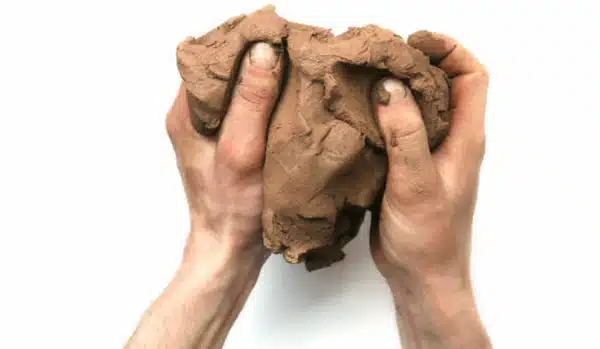

Not so simple, really. The photo above is exactly what I thought of when I heard the word “clay”. A wild clay, in fact. But what does the dictionary say?

From a geological point of view, clay is a sedimentary rock resulting from the decomposition of rocks such as granite under the influence of water and carbonic acid. As there are a great many clay minerals, let’s just mention the 3 main ones used in ceramics:
– kaolinite (a component of porcelain)
– illite
– montmorillonite
So most clays are a blend of these 3 components, and the proportions will determine how they behave during shaping (one of the clay-making techniques) and firing.
Then, during the erosion process, clay particles can form primary clays, kaolin (fine particles with few impurities) and secondary clays (coarser particles with impurities), sandstone or earthenware.
For detailed physical and chemical characteristics, see Brune Somogyi’s book, for example.
As far as I’m concerned, depending on how the clays were formed (primary or secondary), their composition and particle size will vary. This will have a major impact on firing behavior.
OK, so what does this mean in practical terms for me as a ceramics beginner? The differences between clays, stoneware, earthenware or porcelain will determine my final choice for expressing my creativity.
What are the differences? To be continued.